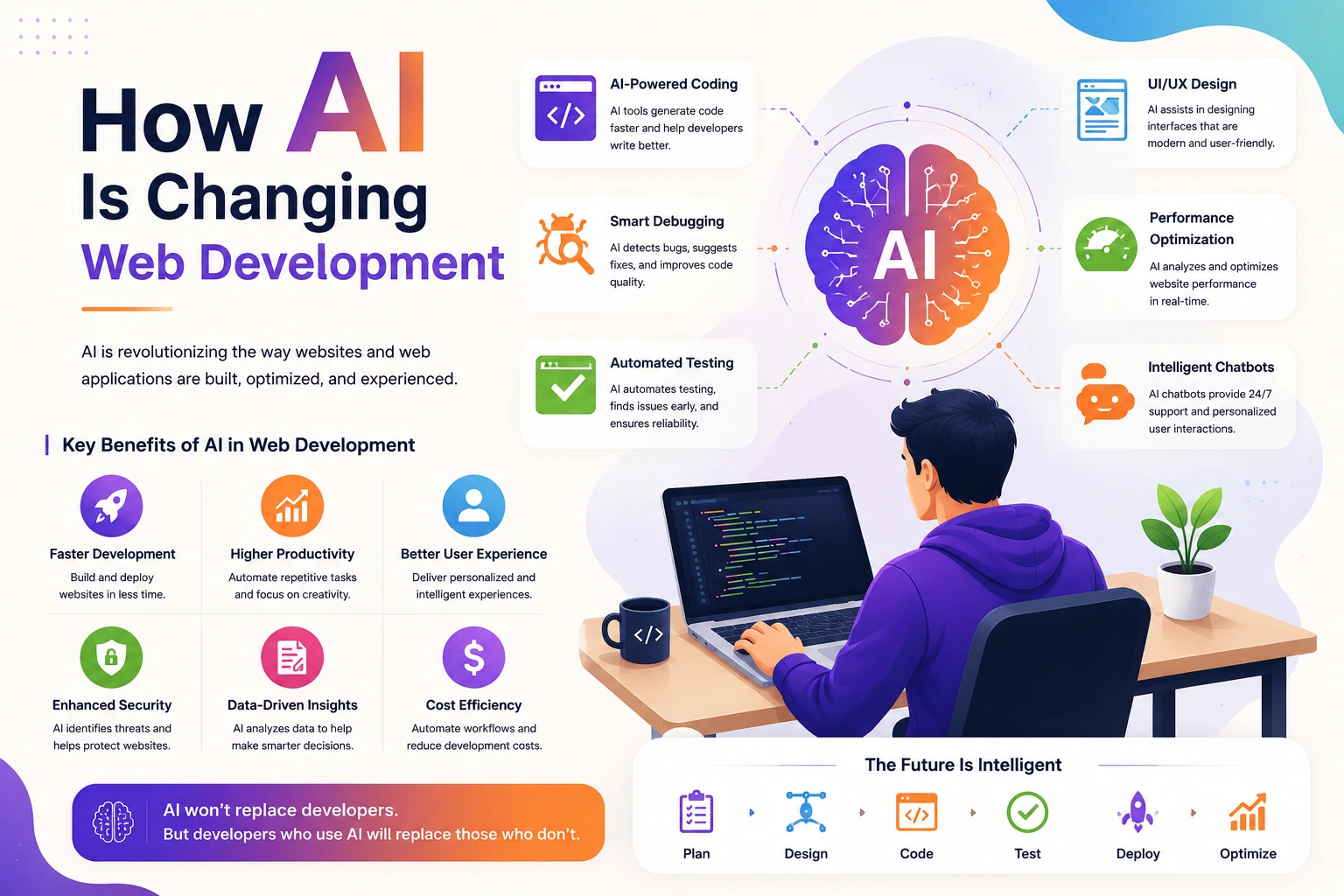
How AI Is Changing Web Development
Artificial Intelligence (AI) is transforming industries across the globe, and web development is no exception. What once required hours of manual coding, testing, and optimization can now be completed more efficiently with the help of AI-powered tools. From generating code and designing user interfaces to improving website performance and enhancing user experiences, AI is reshaping how modern websites and web applications are built.
In this article, we'll explore how AI is changing web development, its benefits, challenges, and what developers and businesses can expect in the future.
What Is AI in Web Development?
AI in web development refers to the use of machine learning, natural language processing, and automation technologies to assist developers in building, maintaining, and optimizing websites and web applications.
AI can help with:
- Code generation
- Bug detection
- UI/UX design
- Content creation
- Testing automation
- Performance optimization
- Customer support
- Data analysis
Rather than replacing developers, AI acts as a powerful assistant that improves productivity and efficiency.
1. Faster Code Generation
One of the biggest impacts of AI is automated code generation.
Modern AI tools can:
- Generate code snippets
- Create entire functions
- Suggest code completions
- Convert requirements into code
- Refactor existing code
Developers can spend less time writing repetitive code and more time focusing on architecture, business logic, and problem-solving.
Benefits
✅ Faster development cycles
✅ Reduced repetitive tasks
✅ Increased productivity
2. Smarter Debugging and Error Detection
Finding bugs can often consume a significant portion of development time.
AI-powered development tools can:
- Identify potential bugs
- Suggest fixes
- Detect security vulnerabilities
- Analyze code quality
These capabilities help developers resolve issues faster and produce more reliable applications.
Benefits
✅ Fewer bugs in production
✅ Faster troubleshooting
✅ Improved code quality
3. Improved User Experience (UX)
AI is enabling websites to deliver more personalized user experiences.
Examples include:
- Product recommendations
- Personalized content
- Smart search functionality
- Adaptive interfaces
- Behavior-based suggestions
Platforms like e-commerce stores and SaaS applications use AI to understand user behavior and provide tailored experiences.
Benefits
✅ Higher engagement
✅ Better customer satisfaction
✅ Increased conversions
4. AI-Powered Chatbots and Virtual Assistants
Customer support has been revolutionized by AI chatbots.
Modern AI assistants can:
- Answer customer questions
- Provide product recommendations
- Handle support requests
- Assist with bookings and orders
Businesses can offer 24/7 support without significantly increasing operational costs.
Benefits
✅ Instant customer assistance
✅ Reduced support workload
✅ Better customer service
5. Automated Testing
Testing is essential for maintaining high-quality web applications.
AI-powered testing tools can:
- Generate test cases
- Detect UI issues
- Predict potential failures
- Automate regression testing
This reduces manual testing efforts and improves software reliability.
Benefits
✅ Faster releases
✅ Better software quality
✅ Lower testing costs
6. Better Website Performance Optimization
Website speed plays a major role in user experience and SEO.
AI can help optimize:
- Images
- Database queries
- Caching strategies
- Resource loading
- Performance bottlenecks
AI-driven monitoring tools continuously analyze website performance and suggest improvements.
Benefits
✅ Faster page load times
✅ Improved SEO rankings
✅ Better user retention
7. AI-Assisted Web Design
Designing modern user interfaces often requires significant time and expertise.
AI design tools can:
- Generate layouts
- Suggest color schemes
- Create design prototypes
- Improve accessibility
- Recommend UX enhancements
Developers and designers can quickly create professional-looking interfaces while maintaining consistency.
Benefits
✅ Faster design workflows
✅ Improved design quality
✅ Reduced design costs
8. Enhanced Cybersecurity
Cybersecurity threats continue to evolve, making proactive protection essential.
AI can help identify:
- Suspicious activities
- Malware threats
- Login anomalies
- Fraudulent transactions
- Potential vulnerabilities
AI-powered security systems can respond to threats much faster than manual monitoring.
Benefits
✅ Improved security
✅ Faster threat detection
✅ Reduced risk of data breaches
9. AI for Content Creation
Many businesses rely on content marketing to attract visitors and customers.
AI tools can assist with:
- Blog outlines
- Product descriptions
- Meta titles
- Meta descriptions
- SEO optimization
- Social media content
While human review remains important, AI significantly accelerates content production.
Benefits
✅ Faster content creation
✅ Better SEO workflows
✅ Increased marketing efficiency
10. Smarter Search and Recommendations
Users expect websites to deliver relevant results quickly.
AI-powered search systems can:
- Understand user intent
- Correct spelling mistakes
- Predict search queries
- Deliver personalized recommendations
This creates a more intuitive and satisfying user experience.
Benefits
✅ Better search accuracy
✅ Higher engagement
✅ Increased sales opportunities
Challenges of AI in Web Development
Despite its advantages, AI also presents challenges.
Over-Reliance on AI
Developers should not blindly trust AI-generated code. Human review is still essential.
Security Risks
Poorly reviewed AI-generated code can introduce vulnerabilities.
Data Privacy Concerns
AI systems often require large datasets, raising privacy and compliance considerations.
Skill Adaptation
Developers need to learn how to effectively use AI tools while maintaining strong programming fundamentals.
Will AI Replace Web Developers?
The short answer is no.
AI can automate repetitive tasks, generate code, and assist with development, but it cannot replace:
- Strategic thinking
- Complex problem-solving
- Business analysis
- System architecture
- Client communication
- Creative decision-making
Instead of replacing developers, AI is making skilled developers more productive.
Developers who embrace AI will likely gain a competitive advantage over those who ignore it.
The Future of AI in Web Development
Over the next few years, AI is expected to become even more integrated into development workflows.
Future trends may include:
- AI-generated full-stack applications
- Advanced automated testing
- Smarter design systems
- Improved code reviews
- More intelligent development environments
- Enhanced personalization capabilities
Businesses that adopt AI-powered development practices will be better positioned to innovate and compete in an increasingly digital marketplace.
Final Thoughts
AI is changing web development by making coding, testing, design, optimization, and customer interactions more efficient. While AI won't replace developers, it is becoming an essential tool for building modern web applications faster and more effectively.
For businesses, AI offers opportunities to improve customer experiences, reduce costs, and accelerate digital transformation. For developers, it provides powerful tools that increase productivity and allow greater focus on solving real-world problems.
The future of web development is not AI versus developers—it's AI working alongside developers to create better digital experiences.