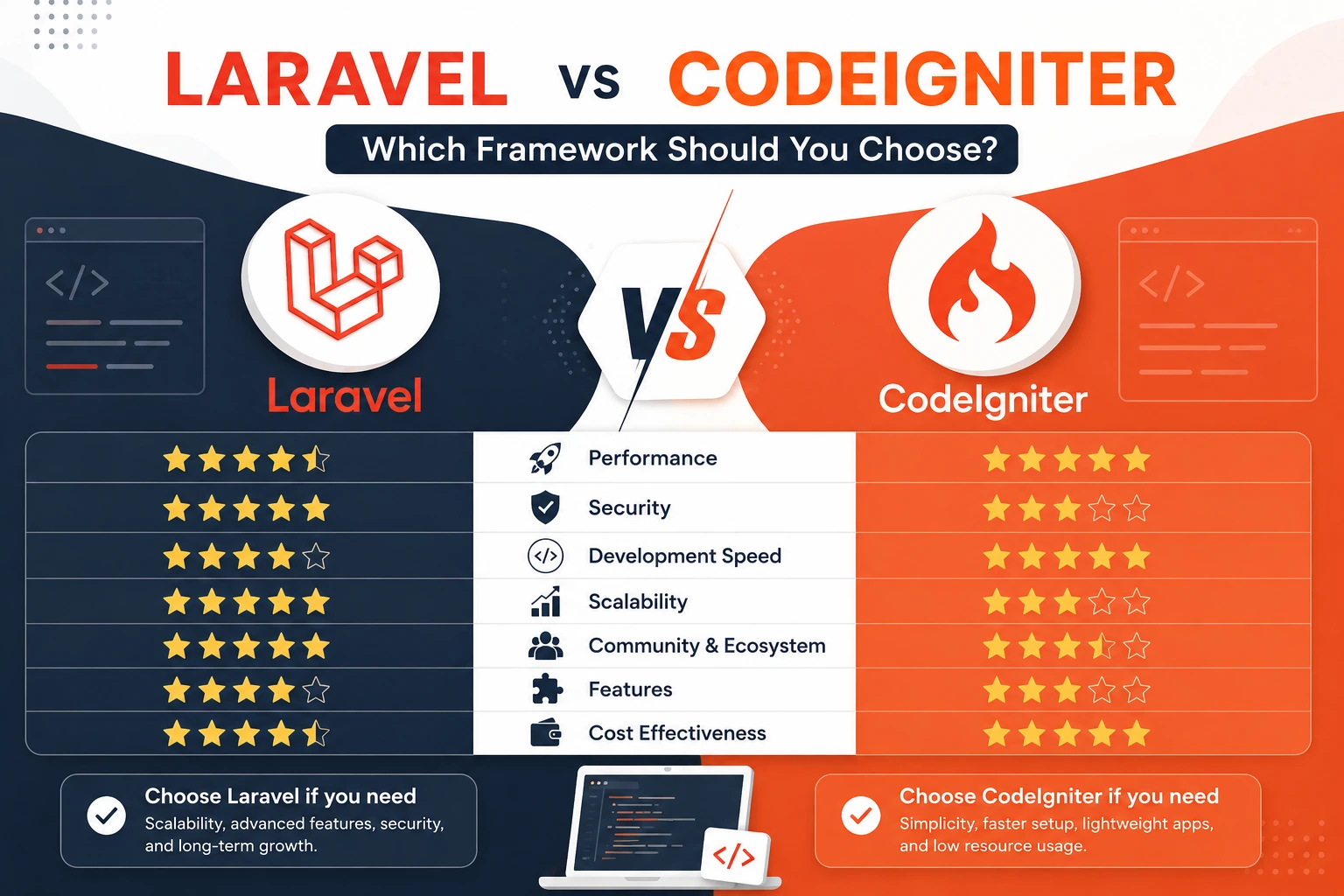
Laravel vs CodeIgniter: Which Framework Should You Choose?
Choosing the right PHP framework is one of the most important decisions when building a web application. Two of the most popular PHP frameworks are Laravel and CodeIgniter. Both have been widely used for years and offer powerful features for web development.
However, they serve different purposes and are better suited to different types of projects. In this guide, we'll compare Laravel and CodeIgniter across key areas to help you decide which framework is the best fit for your next project.
What Is Laravel?
Laravel is a modern, open-source PHP framework that follows the MVC (Model-View-Controller) architecture. It is known for its elegant syntax, rich ecosystem, built-in security features, and developer-friendly tools.
Laravel is commonly used for:
- Enterprise applications
- SaaS platforms
- E-commerce websites
- APIs
- CRM systems
- Custom business applications
What Is CodeIgniter?
CodeIgniter is a lightweight PHP framework designed for simplicity and speed. It provides a minimal setup and a small footprint, making it suitable for smaller projects and developers who prefer flexibility.
CodeIgniter is commonly used for:
- Small business websites
- Lightweight web applications
- Rapid prototyping
- Legacy PHP projects
Laravel vs CodeIgniter: Feature Comparison
Feature Laravel CodeIgniter
Learning Curve | Moderate | Easy
Performance | Excellent | Very Fast
Security | Advanced Built-in Security | Basic Security Features
Database ORM | Eloquent ORM | Query Builder
Authentication | Built-in | Requires Custom Setup
Community Support | Large | Moderate
Package Ecosystem | Extensive | Limited
API Development | Excellent | Good
Scalability | High | Moderate
Enterprise Projects | Ideal | Limited
1. Ease of Learning
Laravel
Laravel provides a modern development experience but includes many advanced concepts such as:
- Service Containers
- Dependency Injection
- Middleware
- Queues
- Events
New developers may need some time to become comfortable with Laravel's ecosystem.
CodeIgniter
CodeIgniter has a simpler structure and minimal configuration requirements. Developers can start building applications quickly without learning many advanced concepts.
Winner: CodeIgniter
For beginners and simple projects, CodeIgniter is easier to learn.
2. Performance
Performance is critical for user experience and SEO.
Laravel
Laravel includes many powerful features, but these features add some overhead. However, with proper optimization, Laravel applications can perform exceptionally well.
Features include:
- Route caching
- Query caching
- Redis integration
- Queue processing
CodeIgniter
CodeIgniter is lightweight and has a smaller footprint. As a result, it often delivers faster out-of-the-box performance for small applications.
Winner: CodeIgniter
For raw speed in simple applications, CodeIgniter has a slight advantage.
3. Security
Security is essential for modern web applications.
Laravel
Laravel provides built-in protection against:
- SQL Injection
- CSRF attacks
- XSS vulnerabilities
- Session hijacking
It also includes secure authentication and password hashing systems.
CodeIgniter
CodeIgniter offers basic security tools, but developers often need to implement additional security measures manually.
Winner: Laravel
Laravel provides stronger security features out of the box.
4. Database Management
Laravel
Laravel uses Eloquent ORM, which allows developers to work with databases using expressive and readable syntax.
Example benefits:
- Cleaner code
- Easier relationships
- Faster development
CodeIgniter
CodeIgniter offers a Query Builder that works well but lacks the advanced capabilities of Eloquent ORM.
Winner: Laravel
Eloquent ORM significantly improves productivity and maintainability.
5. Development Speed
Laravel
Laravel includes many built-in tools:
- Authentication
- Authorization
- Queues
- Scheduling
- Email handling
- File storage
These features reduce development time for complex applications.
CodeIgniter
Developers often need to create many functionalities manually.
Winner: Laravel
Laravel accelerates development for medium and large projects.
6. Scalability
As businesses grow, applications need to handle more users and data.
Laravel
Laravel offers:
- Queue systems
- Caching
- Event broadcasting
- Microservices support
- Cloud deployment options
CodeIgniter
CodeIgniter can scale but requires more custom implementation for larger systems.
Winner: Laravel
Laravel is better suited for long-term growth.
7. API Development
Modern applications frequently require APIs for mobile apps and third-party integrations.
Laravel
Laravel excels in API development through:
- Laravel Sanctum
- API Resources
- Rate Limiting
- Token Authentication
CodeIgniter
API development is possible but requires more manual configuration.
Winner: Laravel
Laravel provides a more complete API development experience.
8. Community and Ecosystem
Laravel
Laravel has one of the largest PHP communities.
Its ecosystem includes:
- Laravel Forge
- Laravel Vapor
- Laravel Horizon
- Laravel Nova
- Laravel Sanctum
CodeIgniter
CodeIgniter has an active community but a smaller ecosystem.
Winner: Laravel
The larger ecosystem makes development faster and easier.
When Should You Choose Laravel?
Laravel is the better choice if you need:
✅ Custom business applications
✅ SaaS platforms
✅ E-commerce websites
✅ REST APIs
✅ CRM systems
✅ Enterprise solutions
✅ Long-term scalability
✅ Advanced security
Laravel is ideal for businesses planning future growth and requiring robust functionality.
When Should You Choose CodeIgniter?
CodeIgniter is a good choice if you need:
✅ Small websites
✅ Lightweight applications
✅ Rapid development
✅ Minimal server resources
✅ Simple project requirements
For small projects with limited complexity, CodeIgniter can be a practical option.
Final Verdict
If you're building a modern web application in 2026, Laravel is generally the better choice. Its powerful ecosystem, advanced security, scalability, API capabilities, and developer productivity tools make it the preferred framework for most professional projects.
CodeIgniter remains a solid option for lightweight applications and developers who prioritize simplicity and speed. However, for businesses seeking long-term growth and maintainability, Laravel offers significantly more value.
Our Recommendation
For startups, businesses, e-commerce platforms, SaaS products, and custom web applications, Laravel is usually the best investment because it provides the flexibility and scalability needed to support future expansion.