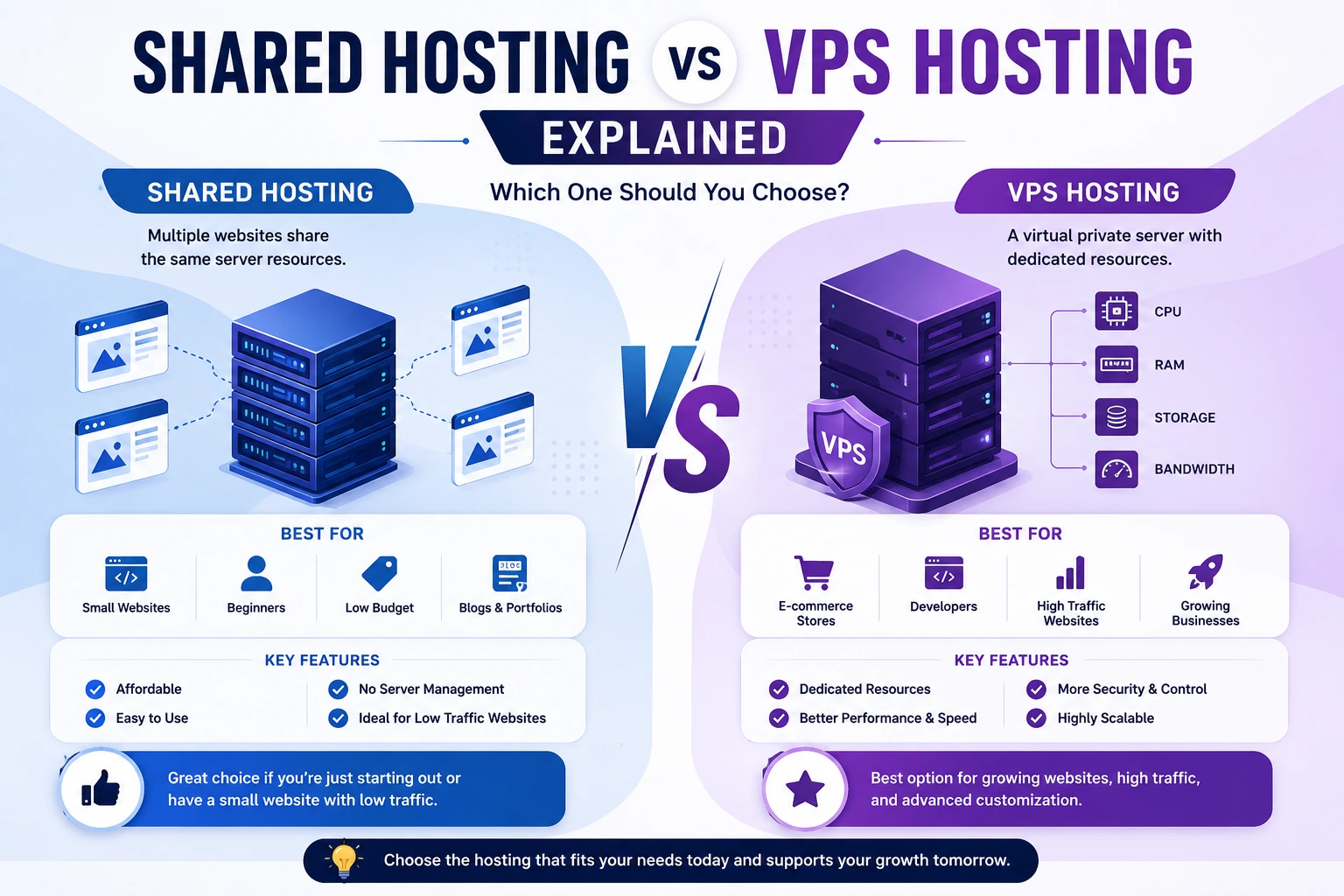
Shared Hosting vs VPS Hosting Explained: Which One Should You Choose?
Choosing the right hosting solution is one of the most important decisions when launching a website. Whether you're starting a blog, business website, portfolio, e-commerce store, or custom web application, your hosting directly affects performance, security, scalability, and user experience.
Two of the most common hosting options are Shared Hosting and VPS Hosting (Virtual Private Server). While both can host websites effectively, they serve different needs and budgets.
In this guide, we'll explain the differences between Shared Hosting and VPS Hosting, their advantages and disadvantages, and how to determine which option is right for your website.
What Is Shared Hosting?
Shared Hosting is a hosting environment where multiple websites share the same server resources, including:
- CPU
- RAM
- Storage
- Bandwidth
Think of it like living in an apartment building where all residents share common facilities.
Hosting providers manage the server, making Shared Hosting an easy and affordable solution for beginners.
Advantages of Shared Hosting
✅ Low cost
Shared Hosting is the most affordable hosting option available.
✅ Beginner-friendly
No server management knowledge is required.
✅ Easy setup
Most providers offer one-click installations and user-friendly control panels.
✅ Maintenance handled by provider
Server updates, security patches, and maintenance are managed for you.
Disadvantages of Shared Hosting
❌ Limited resources
Resources are shared among many websites.
❌ Lower performance
Traffic spikes on neighboring websites can affect your site's speed.
❌ Limited customization
You have little control over server configurations.
❌ Scalability limitations
Large or rapidly growing websites may outgrow shared hosting.
What Is VPS Hosting?
VPS (Virtual Private Server) Hosting divides a physical server into multiple virtual servers. Each VPS has dedicated resources and operates independently.
Think of it as owning a private apartment instead of sharing common resources with everyone.
VPS Hosting provides more power, flexibility, and control than Shared Hosting.
Advantages of VPS Hosting
✅ Dedicated resources
Your allocated CPU and RAM are reserved for your website.
✅ Better performance
Traffic on other websites won't significantly affect your site.
✅ Greater security
Virtual isolation improves security.
✅ Root access
Developers can customize server settings and install software.
✅ Better scalability
Resources can often be upgraded as your website grows.
Disadvantages of VPS Hosting
❌ Higher cost
VPS Hosting costs more than Shared Hosting.
❌ Technical knowledge required
Managing a VPS may require server administration skills.
❌ More responsibility
Depending on the hosting plan, you may need to handle maintenance and security.
Shared Hosting vs VPS Hosting Comparison
Feature | Shared Hosting | VPS HostingCost | Low | Moderate
Performance | Good | Excellent
Scalability | Limited | High
Security | Basic | Advanced
Resource Allocation | Shared | Dedicated
Customization | Limited | Extensive
Traffic Handling | Moderate | High
Server Control | Minimal | Full/Partial
Suitable for Beginners | Yes | Depends
Suitable for Large Websites | No | Yes
Performance Comparison
Shared Hosting
Performance is generally sufficient for:
- Personal websites
- Small blogs
- Portfolio websites
- New business websites
However, performance can decrease when server resources are heavily used by other websites.
VPS Hosting
VPS provides:
- Faster response times
- Better uptime
- Improved handling of high traffic
- Better application performance
This is especially important for:
- E-commerce stores
- SaaS applications
- Laravel projects
- Business-critical websites
Winner: VPS Hosting
Security Comparison
Shared Hosting
While hosting providers implement security measures, websites still share the same environment.
A vulnerability affecting one website may increase risks for others on the server.
VPS Hosting
Virtual isolation provides an additional layer of protection.
Developers can also implement custom security configurations.
Winner: VPS Hosting
Scalability Comparison
Shared Hosting
Ideal for websites with:
- Low traffic
- Basic requirements
- Limited growth expectations
VPS Hosting
Designed for websites expecting:
- Traffic growth
- Advanced functionality
- Business expansion
Resources can usually be upgraded without migrating to another hosting environment.
Winner: VPS Hosting
Which Hosting Is Best for Laravel Applications?
Laravel applications often require:
- Queue workers
- Cron jobs
- Advanced caching
- Custom server configurations
- Better performance
Shared Hosting
Suitable for:
- Small Laravel projects
- Practice applications
- Beginner projects
- Personal websites
VPS Hosting
Recommended for:
- Production Laravel applications
- Client projects
- SaaS products
- High-traffic websites
Most professional Laravel developers eventually move to VPS hosting because of the additional control and performance.
When Should You Choose Shared Hosting?
Choose Shared Hosting if:
✅ You're launching your first website
✅ You have a limited budget
✅ Your website receives low traffic
✅ You don't want to manage a server
✅ You're creating a portfolio or blog
Examples:
- Personal blogs
- Portfolio websites
- Small business websites
- Landing pages
When Should You Choose VPS Hosting?
Choose VPS Hosting if:
✅ Your website is growing
✅ You need better performance
✅ You require custom server configurations
✅ You're hosting Laravel applications
✅ You expect high traffic
✅ Security is a major concern
Examples:
- Laravel web applications
- E-commerce stores
- SaaS platforms
- Membership websites
- Enterprise solutions
Cost Comparison
Shared Hosting
Typical pricing:
- Budget-friendly
- Suitable for beginners
- Lowest monthly hosting costs
VPS Hosting
Typical pricing:
- Higher monthly cost
- Better performance and resources
- Greater long-term flexibility
Although VPS costs more, many businesses view it as an investment in performance and reliability.
Final Verdict
For beginners, freelancers, bloggers, and small business websites, Shared Hosting is often the best starting point because it's affordable, simple, and easy to manage.
For growing businesses, Laravel applications, e-commerce stores, and websites expecting significant traffic, VPS Hosting is usually the better choice due to its superior performance, security, and scalability.
Our Recommendation
- Start with Shared Hosting if you're launching a simple website.
- Upgrade to VPS Hosting when your traffic, performance needs, or business requirements increase.